Its name, which means "house (of) bed," is also the name of a famous marae in Mahina, Tahiti, the bed in question could be a metaphor for an object or a place designed to accommodate and sustain a deity figure in. (world of darkness). Emory archeologist lists the marae as a Tupuna marae (family) of the chiefdom (mata'eina'a) Tou Fare Huahine.
Tane, the dominant god of Huahine, was worshiped on this marae, which served the community of Huahine Nui.
Tane was the god of war and fish of Huahine. It was associated with the construction of canoes, making adzes and the braiding ropes. The god Oro, who was introduced later, was also worshiped on the marae Manunu.
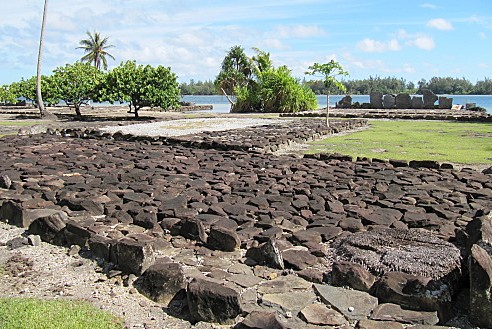
Besides the ava'a (bed for a god or platform for placing images) is the tomb of Raiti, the last high priest of Maeva. When he died in 1915, a stone block of the marae collapsed. In accordance with his last wishes, he was buried on the site of the marae. The foundations for a small fare pote'e (round house containing sacred drums and ceremonial items) is inside the marae.
Look carefully at the stone block on the ahu airport side : you will see the petroglyph of a turtle. The turtle was seen as a reflection of the god in the sea.
The fish traps in the lagoon around the village of Maeva are still used today. The fish enters between the openings in the rising and falling tides and is then captured with large nets. This is not only a very simple method of fishing, it is a primitive form of aquaculture, since the park keeps the fish taken alive. Once, these fish traps were an abundant source of food for the families of chiefs.
The term rauhuru refers to the dried banana leaves. Emory lists it as a marae tupuna (family), without specifying its chiefdom of attachment. He mentions the presence of petroglyphs (canoes) on limestone slabs (corals) at the ends west of the north face of ahu (high part) and also other petroglyphs, turtles .









 Marae Fare Ro’i